
3 Arabic Words in Surah Al-Mulk That Don’t Mean What You Think
When we read Surah Al-Mulk every night, it’s easy to let our eyes glide over the translation without truly grasping the weight of the words. English translations do their best, but classical Arabic is a multi-layered language where a single root word can carry an entire universe of meaning.
If you are looking to elevate your nightly recitation from a routine habit into a deeply emotional experience, understanding these three specific words from Surah Al-Mulk will completely change how you view this chapter.
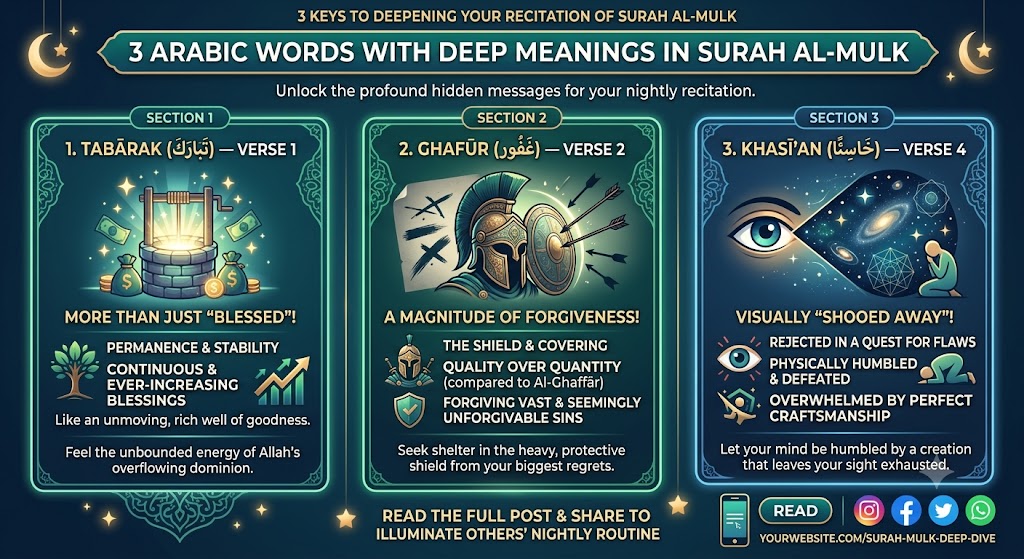
1. Tabārak (تَبَٰرَكَ) — Verse 1
“Blessed is He in whose hand is dominion…”
Most translations render Tabārak simply as “Blessed.” While not incorrect, this translation misses the incredible dynamism of the word.
The Deeper Meaning:
In Arabic, Tabārak comes from the root B-R-K ($ب-ر-ك$), which is tied to the concept of a Barakah (blessing). However, linguistically, the root also means permanence, stability, and abundance—like a deep well of water that never runs dry, or a camel that kneels down firmly and cannot be easily moved.
Furthermore, the specific grammatical weight of the pattern Tafā’ala ($تَفَاعَلَ$) implies that this blessing is continuous, ever-increasing, and uniquely exalted.
- The Shift in Perspective: When you read “Tabārakalladhī…”, don’t just think “God is blessed.” Think: “Exalted and infinitely overflowing in continuous, permanent goodness is the One who holds all dominion.” His blessings are not static; they are actively expanding into your life every single second.
2. Ghafūr (غَفُور) vs. Ghaffār — Verse 2
“…and He is the Exalted in Might, the Forgiving.”
Allah uses the name Al-Ghafūr in the very second verse of this Surah, right after mentioning that life and death were created as a test. We know it means “The Forgiving,” but why did Allah choose Ghafūr over His other name of forgiveness, Ghaffār?
The Deeper Meaning:
Both names come from the root Gh-F-R ($غ-ف-ر$), which originally means to cover, to shield, or to protect (like a mighfar, the helmet a warrior wears to protect their head in battle).
- Al-Ghaffār implies quantity—The One who forgives repeatedly, no matter how many times you sin.
- Al-Ghafūr implies quality and magnitude—The One who forgives even the heaviest, most massive, and seemingly unforgivable sins.
- The Shift in Perspective: By using Al-Ghafūr directly after establishing that life is a rigorous test, Allah is comforting the reader. He knows we will make catastrophic mistakes during this worldly test. Al-Ghafūr means His forgiveness is heavy enough to completely cover and shield you from the consequences of your biggest regrets, erasing them as if they never happened.
3. Khasī’an (خَاسِئًا) — Verse 4
“Your vision will return to you humbled and fatigued.”
In Verse 4, Allah challenges mankind to look up at the sky to find a flaw, a crack, or a disconnect. He says that no matter how many times you look, your vision will return to you Khasī’an. It is usually translated as “humbled,” “disgraced,” or “defeated.”
The Deeper Meaning:
Linguistically, the word Khasa’a ($خَسَأَ$) is a harsh, casting-off word. Historically, it was the exact word used by Arabs to shoo away an annoying dog or a stray animal (“Khsa!” meaning “Get away!”). It implies being driven away, rejected, and frustrated because you cannot reach your goal.
- The Shift in Perspective: Allah is describing a visual experience that is so overwhelmed by the perfection, vastness, and flawless design of creation that the human eye feels physically “shooed away” and utterly rejected in its quest to find a mistake. Your eyes return to you exhausted (hasīr), defeated by the absolute majesty of Allah’s craftsmanship.
Final Thoughts for Your Next Recitation
The next time you turn off the lights, open your Quran or Mus’haf, and begin reciting Surah Al-Mulk, pause at these words:
- Feel the boundless, overflowing energy of Tabārak.
- Seek shelter in the heavy, protective shield of Ghafūr.
- Let your mind be humbled by the flawless universe that leaves our sight Khasī’an.
Which of these linguistic secrets surprised you the most? Let us know in the comments below, and don’t forget to share this with someone to illuminate their nightly routine!